Kenya Kirinyaga Cimba Station Geisha Natural*1│Light【Justin Coffee】1/2 lb (230g) Estate Coffee, Freshly Roasted
商品介紹


【 Product Name 】
Specialty Estate Coffee Beans-
Kenya Kirinyaga Cimba Station Geisha Natural
------
【 Coffee Imformation 】
Kenya Kirinyaga Cimba Station Geisha Natural
- Coffee Origin: Kenya
- Estate-grown coffee:Kenya Kirinyaga Cimba Station
- Processing Method: Natural
- Variety: 100% Arabica Gesha/Geisha
- Flavor Notes: Tropical fruits, Passion fruit, Pineapple, Sweet orange, Grape, Floral notes.
- Roast Level: Light Roast
- Packaging: 1/4 lb (115 g) or Half-Pound (230g) beans ➡ One-way degassing valve + resealable zipper bag
- Elevation:1880m
- Shelf Life: 4 months (4 months from the roasting date, during which the coffee beans retain their optimal flavor.)
- Nutrition Facts: Not required for coffee
- Origin: Roasted in Taiwan
------
Kenya Kirinyaga Karumandi AB Washed
- Coffee Origin: Kenya
- Estate-grown coffee:Kenya Kirinyaga Karumandi AB
- Processing Method: Washed
- Variety: 100% Arabica -SL28 SL34
- Grade: AB
- Flavor Notes: Frangipani, Honey, Sweet berries, Honey, Sweet-and-Tangy Smoked Plum, Smooth body, Sweet and Juicy.
- Roast Level: Light Roast
- Packaging: 1/4 lb (115 g) or Half-Pound (230g) beans ➡ One-way degassing valve + resealable zipper bag
- Elevation:1800-1900m
- Shelf Life: 4 months (4 months from the roasting date, during which the coffee beans retain their optimal flavor.)
- Nutrition Facts: Not required for coffee
- Origin: Roasted in Taiwan
------
Kenya Kirinyaga Kiunyu AA TOP Washed
- Coffee Origin: Kenya
- Estate-grown coffee:Kenya Kirinyaga Kiunyu AA TOP
- Processing Method: Washed
- Variety: 100% Arabica -SL28 SL34
- Grade: AA Top
- Flavor Notes: Orange, Citrus, Yellow Lemon, Honey, Refreshing Juice-Like Quality, Clean and Bright.
- Roast Level: Light Roast
- Packaging: 1/4 lb (115 g) or Half-Pound (230g) beans ➡ One-way degassing valve + resealable zipper bag
- Elevation:1644m
- Shelf Life: 4 months (4 months from the roasting date, during which the coffee beans retain their optimal flavor.)
- Nutrition Facts: Not required for coffee
- Origin: Roasted in Taiwan
------------
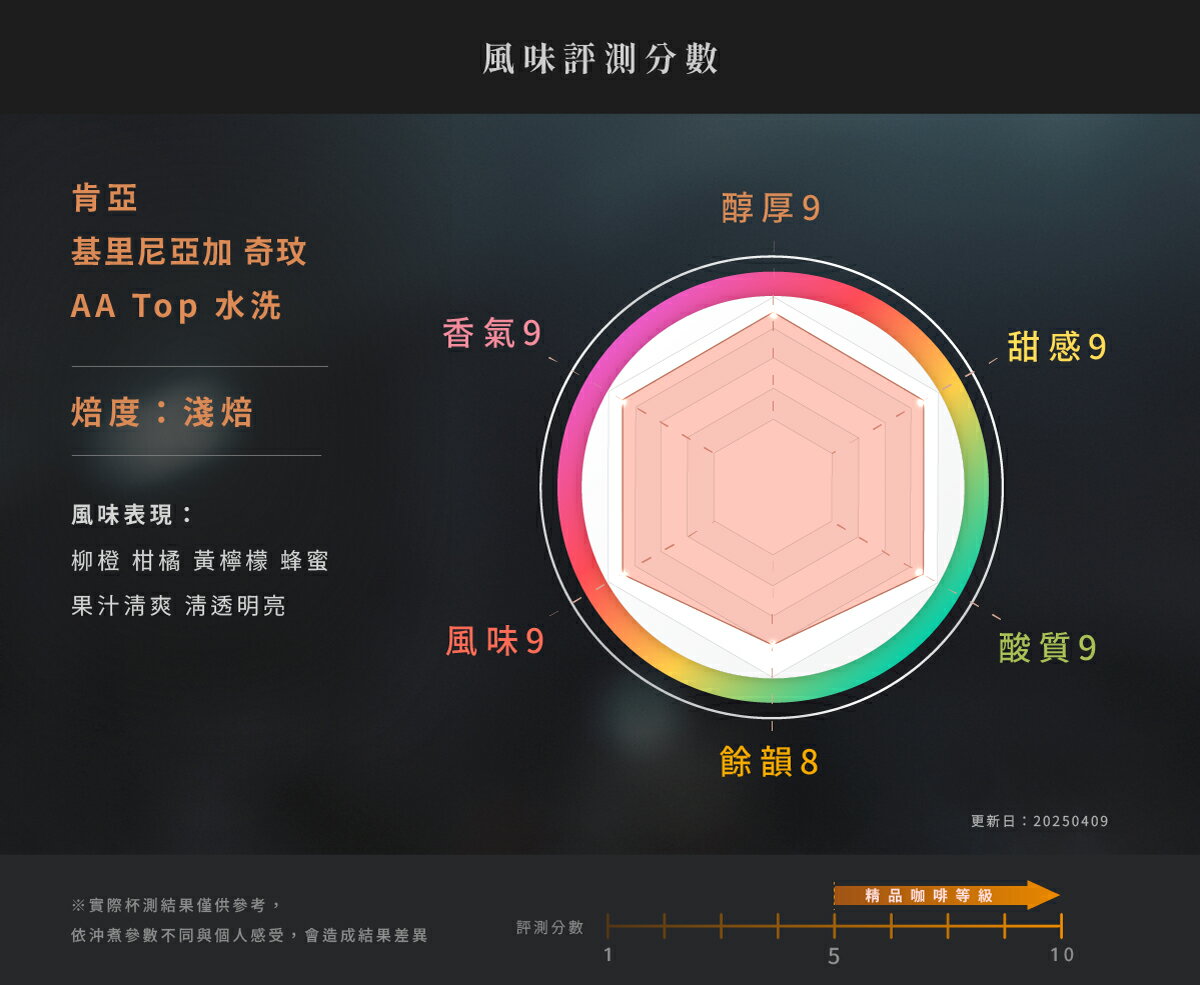


Coffee Flavor
The flavors of coffee are derived from the breakdown of various nutrients in the green coffee beans during roasting. Heat causes these compounds to degrade into a variety of aromatic molecular structures, resulting in a wide spectrum of flavors. High-quality coffee beans naturally possess a rich aroma that evolves at different temperatures—high, medium, and low—offering a delightful and nuanced experience worth savoring.
Kenya Kirinyaga Cimba Station Geisha Natural
Tropical fruits, Passion fruit, Pineapple, Sweet orange, Grape, Floral notes.
-----
Kenya Kirinyaga Karumandi AB Washed
Frangipani, Honey, Sweet berries, Honey, Sweet-and-Tangy Smoked Plum, Smooth body, Sweet and Juicy.
-----
Kenya Kirinyaga Kiunyu AA TOP Washed
Orange, Citrus, Yellow Lemon, Honey, Refreshing Juice-Like Quality, Clean and Bright.

The Kirinyaga region in Kenya is located in the central part of the country, along the southwestern slopes of Mount Kenya. The area sits at elevations ranging from approximately 1,300 to 1,900 meters above sea level, and features fertile volcanic soils and a cool climate, providing ideal conditions for coffee cultivation.
❱ Cimba Washing Station – Dorman Selection, Kenya Geisha Experimental Lot
In Nairobi, the capital of Kenya, the cupping lab of Dorman—widely regarded as the pinnacle of specialty coffee evaluation—stands at the heart of the industry. Its professional team cups between 1,500 and 2,000 samples each week. This is not merely about volume, but about meticulously identifying the finest lots from hundreds of cooperatives and countless auction offerings across the country.
Only coffees selected and branded by Dorman are considered exemplary representations of their origin for that harvest year. The arrival of this “Cimba Geisha” in Taiwan signifies that it has passed an exceptionally rigorous selection process, achieving a perfect balance between the elegance of the Geisha variety and the vibrant intensity imparted by the volcanic soils of Kirinyaga.
A New Expression of Geisha in Kenya
In Kenya, Geisha remains an extremely rare and experimental variety with very limited production. Through close collaboration with Dorman, the exporter has challenged Kenya’s traditional double-washed framework to present this Simba Geisha experimental lot.
Flavor Evolution:
Unlike the classic expectation of pronounced acidity in Kenyan coffees, this Simba Geisha retains a rich blackcurrant foundation while introducing captivating floral aromatics and layered tropical sweetness. Offered in both natural and washed processes, it showcases two distinct expressions of Geisha—refined elegance and vibrant intensity.
Due to its experimental nature, this lot is produced in extremely limited quantities and is not available year-round. If you wish to savor this extraordinary sensory experience, be sure to seize this rare lot.
❱ Karumandi Washing Station
The Karumandi Washing Station is a well-known processing facility in the Kirinyaga region, situated at an altitude of 1,700 to 1,800 meters. It primarily processes coffee varieties such as SL28, SL34, Ruiru 11, and Batian. At Karumandi, coffee undergoes traditional washed processing. After meticulous hand selection, ripe coffee cherries are promptly delivered to the washing station, where they undergo depulping, fermentation, and thorough washing to ensure purity and high quality. The beans are then sun-dried to achieve the ideal moisture content.
Kirinyaga coffee is renowned for its bright acidity and complex flavor profile. Common tasting notes include blackcurrant, berries, and citrus, accompanied by sweet caramel and chocolate undertones.
❱ Kiunyu Washing Station
Established in 1960, the Kiunyu Washing Station is located in Kirinyaga and operates under the Karithathi Farmer Cooperative Society, supported by 3,082 members. The region receives an annual rainfall of approximately 1,100 mm, with an average temperature of 13-24°C. The combination of fertile volcanic soil and an optimal climate contributes to stable and growing coffee production.
With a rising awareness of environmental conservation, the washing station has implemented a wastewater recycling system, returning processed water to the soil while encouraging farmers to plant trees for ecological balance and sustainability.
----
Kenya is a prominent producer of East African specialty coffee, with a population of approximately 6 million engaged in the coffee industry, predominantly through smallholder farmers and cooperative societies. Kenyan coffee trees are primarily cultivated at altitudes between 1,400 meters and 2,000 meters, spanning regions including Ruiri, Thika, Kirinyaga, Mt. Kenya West, Nyeri, Kiambu, and Murang'a, with a focus on the foothills of Mt. Kenya and the Aberdare ranges. The main coffee-growing areas encircle Mount Kenya, each possessing its unique regional flavor profiles. For instance, the Nyeri region is renowned for its blackcurrant and prune flavors.
Many coffee-growing regions in Kenya strive to preserve their native forest ecosystems, protecting the natural gene pool and supporting the propagation of wild coffee varieties, thereby fostering diverse coffee trees. In 1930, the unique Kenyan coffee varieties SL28 and SL34 were developed and named by the Scott Laboratories. These varieties emerged in such a conducive environment, benefiting from the region’s commitment to maintaining a healthy and diverse coffee ecosystem.
Many coffee-growing regions in Kenya strive to preserve their native forest ecosystems, protecting the natural gene pool and supporting the propagation of wild coffee varieties, thereby fostering diverse coffee trees. In 1930, the unique Kenyan coffee varieties SL28 and SL34 were developed and named by the Scott Laboratories. These varieties emerged in such a conducive environment, benefiting from the region’s commitment to maintaining a healthy and diverse coffee ecosystem.

Arabica Coffee Variety – Geisha/Gesha Variety
Geisha coffee, once named one of the "World's Top 10 Most Expensive Coffees" by Forbes, is a legendary name in the world of specialty coffee. However, there is significant confusion surrounding the Geisha variety, as several genetically distinct plant types are referred to as Geisha, many of which share a similar geographic origin in Ethiopia. Recent genetic diversity analysis conducted by the World Coffee Research confirms that the T2722 variety cultivated in Panama is both unique and consistent. When well-managed in high-altitude regions, this variety is strongly correlated with exceptional cupping quality and is renowned for its delicate floral aroma, jasmine notes, and peach-like fragrance.
Regarding the name "Geisha," the spellings "Geisha" and "Gesha" are often used interchangeably. This is related to phonetic transliteration, as there is no fixed translation from Ethiopian dialects to English. The variety was originally recorded as "Geisha" in planting records. Over the decades, coffee researchers and cultivation databases maintained this spelling, leading to its widespread promotion and use within the coffee industry. The variety was first collected from a mountain in Ethiopia, the name of which is typically translated into English as either "Gesha" or "Geisha."
In recent years, the cultivation of the Geisha variety has gained popularity worldwide, achieving remarkable success in major coffee competitions. This includes regions in Central and South America such as Guatemala, Costa Rica, El Salvador, Colombia, and Peru, where the variety has often been transplanted from Panama's T2722. Additionally, Taiwan has also begun cultivating Geisha in many high-altitude regions. Typically, the higher the elevation, the more enchanting the coffee’s flavor becomes.
Arabica Coffee Varieties – SL28 & SL34
Developed and named in the 1930s by Scott Laboratories, the distinctive Kenyan varieties SL28 and SL34 originated within a rich native forest ecosystem.
SL28 is a hybrid with lineage tracing back to French Mission, Mocha, and Yemeni Typica. It was originally bred with the goal of achieving high yields while maintaining excellent cup quality and resistance to pests and diseases. Although its production levels did not meet expectations, SL28 is renowned for its copper-colored leaves and bean shape resembling broad beans, offering exceptional sweetness, balance, and complex flavor profiles, often highlighted by pronounced citrus and dried plum notes.
SL34 shares a similar flavor profile with SL28, featuring complex acidity and a pleasant sweet finish. Compared to SL28, it presents a heavier body, richer mouthfeel, and a cleaner cup. Its lineage includes French Mission, Bourbon, and a greater proportion of Typica genetics. While its bean appearance is similar to SL28, SL34 demonstrates better adaptability to sudden heavy rainfall.
-----
Kenya Coffee Grading System:
Cup Quality Grades – In descending order: TOP, PLUS, FAQ (Fair Average Quality).
Bean Size Grades – The most common categories are AA, AB, and PB (Peaberry).
 (Coffee Processes)
The term "processing methods" refers to the process of transforming ripe red coffee cherries into dried green beans. Each method has its advantages and disadvantages, influenced by the natural environment and the specific needs of the coffee-producing region. As a result, different regions adopt the processing method most suited to their conditions. This batch uses the following washed processing methods, described below:
【Washed / Wet Processed】
Also known as the wet process, this method involves removing the skin and pulp of the coffee cherries before drying. The seeds are then fermented in water tanks to eliminate the remaining mucilage on their surface, followed by thorough washing and drying under sunlight or with mechanical dryers.
The washed process produces a cleaner and crisper flavor profile compared to the natural process. Coffees processed this way typically have lighter body, brighter acidity, and distinct fruit flavors. This method is often associated with specialty coffee due to its clarity and vibrant flavor expression.
【Natural Process / Sundried / Dry Processed】
Also known as the natural drying method or unwashed process, the natural process is one of the most traditional and widely used methods of coffee processing. This method does not involve the use of water. Originating in Ethiopia, coffee cherries are harvested and laid out to dry under the sun before being hulled. The seeds remain inside the fruit throughout the extended drying period, absorbing flavors from the skin, pulp, and mucilage. This process enhances the coffee's sweetness and body, often resulting in unique and distinctive aromas.
Producers spread the cherries on drying beds, which may consist of terraces or raised platforms. Over the course of 3 to 6 weeks, the cherries undergo fermentation. Producers turn the cherries regularly to ensure even drying and to prevent spoilage. During this time, the sugars in the fruit and the mucilage adhered to the seeds develop complex flavors, contributing to a sweeter profile.
Once dried, the fruit layers are mechanically removed from the seeds. Natural-processed coffee is often juicy and syrupy, with a rich flavor that makes the effort behind this method well worth it.


【Manufacturer Information】
JUSTIN INTERNATIONAL FOOD ENTERPRISE CO., LTD.
Tel: +886-3-358-6611
1st Floor, No. 30, Lane 120, Daxing Road, Taoyuan District, Taoyuan City
▶This product is covered by a NT$10 million product liability insurance.
▶Food Industry Registration Number: F-165601955-00000-0
▶ Our company’s cupper is certified as a CQI International Coffee Quality Appraiser.


Recommended Products


規格說明


出貨日 & 付款說明

※ For detailed shipping and payment information, invoices, overseas ordering instructions, etc., please click here to enter.
相關商品


