

Ethiopia Guji Hambella Benti Nenka G1 Natural


Coffee Flavor
The flavors of coffee are derived from the breakdown of various nutrients in the green coffee beans during roasting. Heat causes these compounds to degrade into a variety of aromatic molecular structures, resulting in a wide spectrum of flavors. High-quality coffee beans naturally possess a rich aroma that evolves at different temperatures—high, medium, and low—offering a delightful and nuanced experience worth savoring.
Ethiopia Guji Hambella Benti Nenka G1 Natural
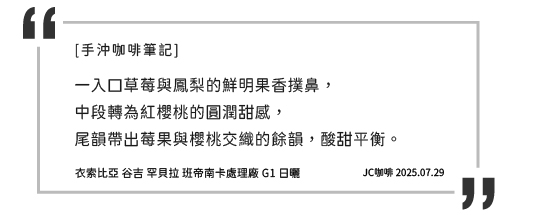
Strawberry, Pineapple, Red Cherry, Creamy Mouthfeel , Thick and Syrupy Body, lingering finish of Berries and Cherries

班帝南卡處理廠(Benti Nenka Washing Station)
Located at elevations ranging from 1,900 to 2,300 meters above sea level, with an average altitude higher than that of Yirgacheffe, this area is one of the key factors behind the rapid rise of the Guji region. The washing station collects coffee cherries from more than 700 surrounding smallholder farmers, whose farms are situated at these higher elevations. The small-scale farming approach allows producers to focus closely on the cultivation of their coffee trees, ensuring the production of high-quality coffee. The region’s natural terroir imparts vibrant and expressive flavor profiles, giving these coffees strong competitiveness in the international market.
Here, the station works closely with smallholder farmers through a vertically integrated model. This collaborative approach not only enhances coffee quality but also supports the development of the local economy. Through these joint efforts, Benti Nenka and the surrounding farmers ensure that every bean fully expresses the distinctive characteristics of the Guji region.
----
衣索比亞 谷吉 罕貝拉產區簡介Guji Hambela, Ethiopia – Region Overview
Ethiopia carries a coffee heritage spanning over a thousand years. Following the discovery of coffee in the Kaffa region, cultivation gradually expanded into the southwestern coffee-growing areas as well as the Harrar region. In recent years, Guji has emerged as a newly developed coffee-producing region in Ethiopia, gaining significant recognition over the past decade. Today, the Guji region is primarily divided into Uraga, Hambela, and Shakiso.
Smallholder farmers surrounding the washing stations mainly cultivate relatively newer coffee varieties. With most farms located at elevations above 2,000 meters, the natural terroir contributes to the coffees’ captivating and complex flavor profiles. Situated in southwestern Ethiopia, Guji features a highland landscape with distinct dry and rainy seasons and abundant rainfall. The presence of nearby streams and underground spring water provides clean and plentiful water resources, enabling excellent washed processing at local stations. This also allows high-quality heirloom varieties to fully express their clarity and purity in the cup. The rise of the Guji region has undoubtedly become one of the most important trends in Ethiopia’s coffee development in recent years.
Hambela, located in the Guji region, is a high-altitude forest community situated at around 2,300 meters above sea level. To maintain harmony with the natural environment, coffee cherries are typically harvested between September and December each year.
Most coffee farms in Ethiopia grow within wild, natural forests, where coffee cultivation has been passed down through generations. Farmers also cultivate indigenous banana plants, intercropping native coffee varieties among the banana trees. Livestock such as cattle, sheep, and horses roam freely within these forested landscapes, reflecting a traditional and sustainable way of life.
With generations of accumulated experience, local producers are able to carry out coffee processing with remarkable precision. The coffees from this region are carefully cultivated, and cherries are harvested at peak ripeness—deep red to nearly black in color, when sugar content is at its highest. They are then naturally processed using traditional African raised beds made from woven bamboo. At such high elevations, where sunlight and ultraviolet intensity are strong, the cherries are carefully turned throughout the drying process, typically completing within several days.
These exceptional geographical conditions, combined with meticulous processing methods, give rise to the distinctly vibrant and expressive flavor profiles of coffees from the Guji region. This is also a key reason why Guji has gained significant recognition and become one of Ethiopia’s most prominent and rapidly developing coffee regions in recent years.

Arabica Coffee Variety – 74114
The coffee tree, botanically classified under the Rubiaceae family and the Coffea subgenus, is an evergreen tree. Coffee beans are the seeds of the coffee fruit. There are three main varieties: Arabica, Robusta, and Liberica. These three varieties cannot crossbreed to produce different subspecies. The world’s specialty coffee comes from the Arabica variety, and within Arabica, there are various subspecies resulting from evolution, hybridization, and mutation.
Arabica coffee originates from Ethiopia in Africa. To this day, there are hundreds and thousands of wild coffee species within Ethiopia, many of which grow year-round in pristine forests. These indigenous wild species have undergone countless local evolutions, including hybridization, mutation, and crossbreeding, resulting in a vast gene pool of native varieties known as the Arabica gene pool. The native varieties produced within Ethiopia are referred to as Heirloom (古優原生種).
In the 20th century, Ethiopia launched a series of official programs to search for, test, and classify coffee varieties. The 74110 variety made a remarkable impression at the inaugural Ethiopia Cup of Excellence, securing 2nd, 3rd, and 8th place with its washed process lots. Notably, both the 2nd and 3rd place lots received scores above 90 points from the international jury, an outstanding achievement. The first part of the naming is based on the year in which the variety was developed. For example, those beginning with 74 or 75—such as 74110, 74112, 74158, and 74114—are now increasingly common.
The second part, such as 110 or 112, represents the specific selection or batch code of the variety. Collectively, these are referred to as the JARC 74 and 75 series, where JARC stands for the Jimma Agricultural Research Center.
---------
Grade 1 (G1) is the highest grade in Ethiopia’s coffee grading system.
 (Coffee Processes)
The term "processing methods" refers to the process of transforming ripe red coffee cherries into dried green beans. Each method has its advantages and disadvantages, influenced by the natural environment and the specific needs of the coffee-producing region. As a result, different regions adopt the processing method most suited to their conditions. This batch uses the following dry processed methods, described below:
【Natural / Sundried / Dry Processed】
Also known as the natural drying method or unwashed process, the natural process is one of the most traditional and widely used methods of coffee processing. This method does not involve the use of water. Originating in Ethiopia, coffee cherries are harvested and laid out to dry under the sun before being hulled. The seeds remain inside the fruit throughout the extended drying period, absorbing flavors from the skin, pulp, and mucilage. This process enhances the coffee's sweetness and body, often resulting in unique and distinctive aromas.
Producers spread the cherries on drying beds, which may consist of terraces or raised platforms. Over the course of 3 to 6 weeks, the cherries undergo fermentation. Producers turn the cherries regularly to ensure even drying and to prevent spoilage. During this time, the sugars in the fruit and the mucilage adhered to the seeds develop complex flavors, contributing to a sweeter profile.
Once dried, the fruit layers are mechanically removed from the seeds. Natural-processed coffee is often juicy and syrupy, with a rich flavor that makes the effort behind this method well worth it.


【Manufacturer Information】
JUSTIN INTERNATIONAL FOOD ENTERPRISE CO., LTD.
Tel: +886-3-358-6611
1st Floor, No. 30, Lane 120, Daxing Road, Taoyuan District, Taoyuan City
▶This product is covered by a NT$10 million product liability insurance.
▶Food Industry Registration Number: F-165601955-00000-0
▶ Our company’s cupper is certified as a CQI International Coffee Quality Appraiser.


Recommended Products


※ For detailed shipping and payment information, invoices, overseas ordering instructions, etc., please click here to enter.


